
Liquid Response
Incompressible-liquid handling methodology
Fluidstream is engineered around liquid-influenced compression behavior, including liquid events inside the compression chamber that challenge gas-only compressor assumptions.
Fluidstream’s strongest credibility comes from measurable field outcomes: uptime, lower maintenance, reduced emissions, and meaningful production or revenue improvement under real operating conditions.
Fluidstream highlights sustained operation, eliminated venting, and winter-duty reliability as proof that its platform is built for field reality rather than brochure-only assumptions. The result shows dependable performance in demanding operating conditions.
The most commercially powerful multiphase proof point on the site is the Alberta case where Fluidstream helped revive two liquid-loaded wells without adding separation equipment or extra site infrastructure, showcasing unmatched efficiency.
Severe liquid-influenced multiphase operation is a more demanding proof point than clean-gas service. If the technology is stable there, the differentiation argument becomes much stronger anywhere liquids create reliability, restart, or maintenance problems.
Conventional compression is usually selected on the assumption that gas can be kept clean enough for the machine. In real field service, that assumption is often the problem. Liquids do not always stay upstream. Slugs do not arrive on schedule. Restarts do not happen under ideal conditions. Once the stream violates dry-gas assumptions, conventional systems often become protection-driven instead of production-driven.
Once liquids break through, the compressor is exposed to instability, damage risk, and a heavier maintenance burden.
Result: more trips, more intervention, less confidence.Conventional trains are easier to destabilize when inlet quality changes quickly or liquid fraction rises suddenly.
Result: shutdowns, throughput loss, and upset-driven downtime.Liquid fallback after shutdowns creates repeated unloading, cycling, and delayed return to stable operation.
Result: longer restarts and recurring lost production.Protecting a gas-only compressor often means adding more scrubbers, and site complexity.
Result: more equipment, more failure points, and weaker economics.Multiphase compression is not just about accepting liquids. The real advantage is how the system responds to liquid-rich, unstable, and changing field conditions while maintaining control, containment, and reliability.
Fluidstream is engineered around liquid-influenced compression behavior, including liquid events inside the compression chamber that challenge gas-only compressor assumptions.
Operators define a target pressure and the system automatically modulates operation as flow, liquid content, slugs, and pressure conditions change.
Advanced gland sealing is engineered for contained operation with reduced routine process-fluid leakage, reduced operator intervention, and improved site cleanliness.
Electronic seal-condition monitoring provides operators real-time insight into seal wear, enabling proactive maintenance and preventing unplanned downtime or reliability issues.
Operators choose Fluidstream when too much equipment, too many failure points, and too much dependence on clean inlet assumptions are limiting production and weakening project economics.
Reduce dependence on separators, tanks, scrubbers, and flare-dependent process steps in suitable applications so the facility does less defensive work before production can move.
Move mixed streams directly instead of forcing early processing before useful work can be done. This creates a cleaner path from wellstream to value.
Support lower-cost, lower-maintenance applications beyond niche or premium multiphase projects by improving the commercial fit at ordinary sites.
Conventional oil and gas facilities are built around separation. Production is processed through multiple stages: separators, tanks, scrubbers, and compressors before gas can be transported. That approach increases capital cost, expands footprint, adds interconnections, and creates operating constraints that are hard to justify when the stream itself is variable. The more unstable the stream, the more expensive this defensive architecture becomes.
Reduce or remove separators, tanks, scrubbers, and flare-dependent process steps where the operating envelope supports a flow-through design.
Minimize capital investment, installation complexity, and lifecycle maintenance burden by simplifying the facility around fewer major pieces of equipment.
Maintain performance across changing flow conditions, liquid slugs, and unstable production profiles that create difficulty for separation-first systems.
Fluidstream supports a facility-design shift toward less separation-first infrastructure, fewer major equipment items, and a clearer flow-through production approach where the technology can create value earlier in the process. The comparison is not cosmetic. It changes how many pieces of equipment have to work correctly before production moves.
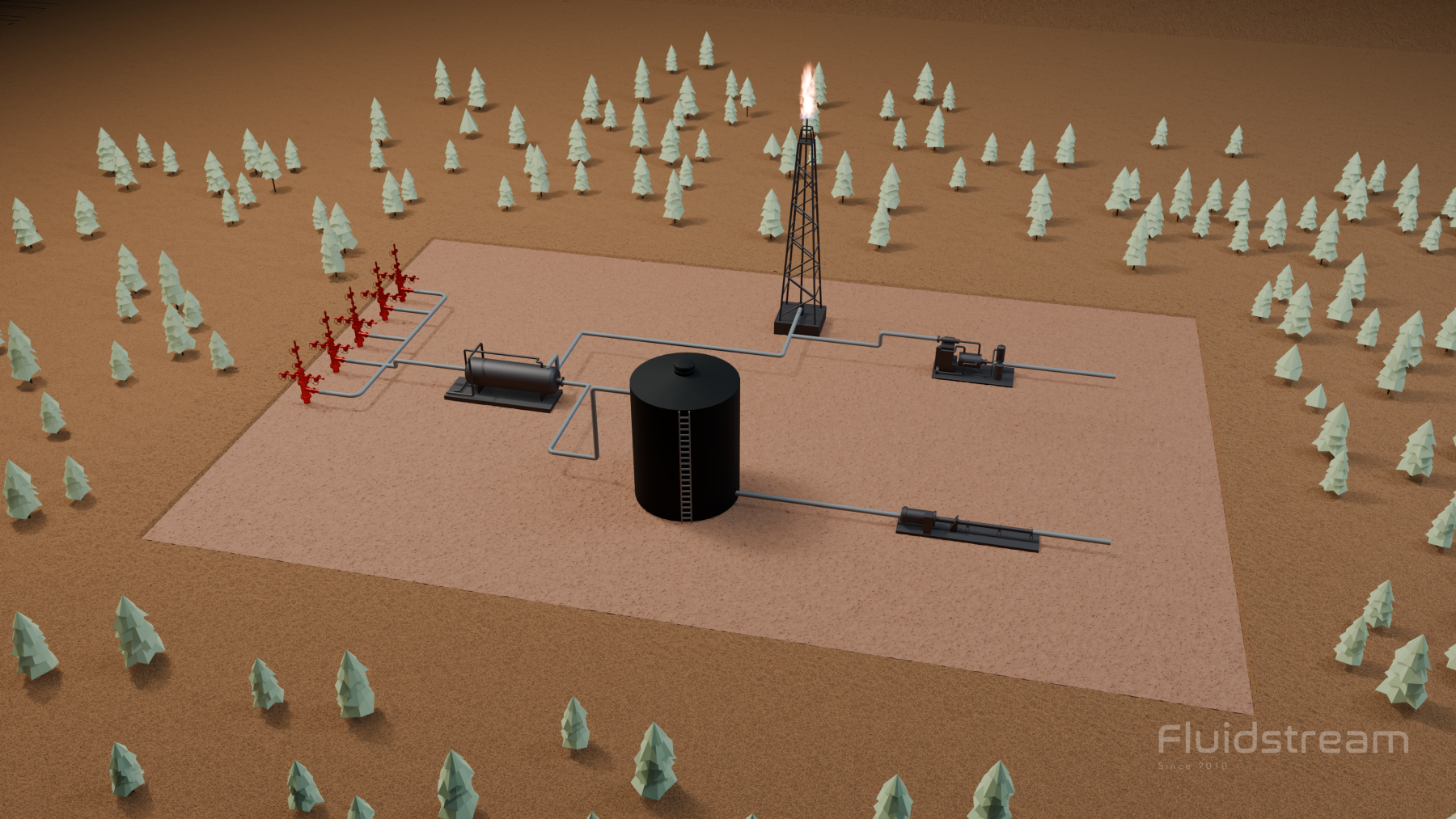 separator
flare
gas compressor
oil tank
oil pump
separator
flare
gas compressor
oil tank
oil pump
High equipment count, larger footprint, more interconnections, more potential failure points, and more dependence on keeping the inlet stream clean enough for the compressor.
 MultiphaseCommander™
Reduced infrastructure, simplified operation, lower cost structure, earlier production movement, and broader applicability across challenging field conditions.
Conventional multiphase technologies are often limited to high-value applications because their capital cost and maintenance complexity restrict where they can be economically deployed. Fluidstream is positioned differently: lower cost and lower maintenance support use across more wells, pads, facilities, and brownfield opportunities where the value case is easier to justify.
Simplified system design reduces upfront investment compared with conventional multiphase solutions that depend on more equipment, more integration, and more field complexity.
Fewer wear-sensitive elements and a simpler system architecture decrease service frequency and lifecycle costs, which strengthens economics long after installation.
Improved economics allow deployment beyond niche or premium projects and into standard wellsites, pads, and facilities where the technology otherwise would not clear the hurdle.
Multiphase compression creates the most value where liquids, slugging, restart issues, or unstable production are already limiting performance. In cleaner, more stable dry-gas service, conventional compression may remain an acceptable fit. Where field conditions are harder, Fluidstream offers a stronger operating and economic case.
If the stream is consistently conditioned, liquids are truly controlled, and the application already fits conventional dry-gas compression, the need for multiphase capability is lower.
This is where Fluidstream creates the strongest advantage: fewer workarounds, less dependence on protective separation, and a better chance of keeping production moving under field conditions that do not stay tidy.
Fluidstream creates the most value where production is being limited by liquids, unstable flow, backpressure, restart problems, or unnecessary surface complexity.
Restore,extend producing life and improve the economics of marginal wells.
Why conventional fails: Gas-only compression loses stability when liquid fallback and intermittent loading disrupt normal suction conditions and turn compression into a recurring intervention problem.
Protect throughput and reduce trips when flow conditions change rapidly.
Why conventional fails: Conventional trains depend on steadier inlet quality and often require more upstream separation as slug frequency rises, which adds complexity without solving the root instability.
Increase deliverability without a full facility rebuild.
Why conventional fails: Adding more surface equipment often increases complexity without materially lowering flowing pressure at the well or improving the stream fit to compression.
Shorten restart time and reduce repeat cycling after shutdowns.
Why conventional fails: Liquid accumulation after shut-ins often requires unloading or repeated cycling before stable compression returns, extending downtime and frustrating operators.
Lower field burden where access, power, and maintenance resources are limited.
Why conventional fails: Separation-heavy layouts add equipment, controls, and intervention requirements that are harder to support in remote service environments and cost more to keep alive.
Capture more gas value with fewer process steps and less wasted production.
Why conventional fails: Processing requirements can exceed the value of lower-rate or variable mixed streams when too many steps are needed before compression, leaving gas stranded or uneconomic to recover.
Use Fluidstream’s technical review when liquids, unstable flow, restart pain, scrubber breakthrough, or excessive maintenance suggest that the current compression approach is mismatched to the stream.